Blogs
Why Has Lagos Become a Battleground for Global Patent Wars?
By Dr Tolulope Adekola
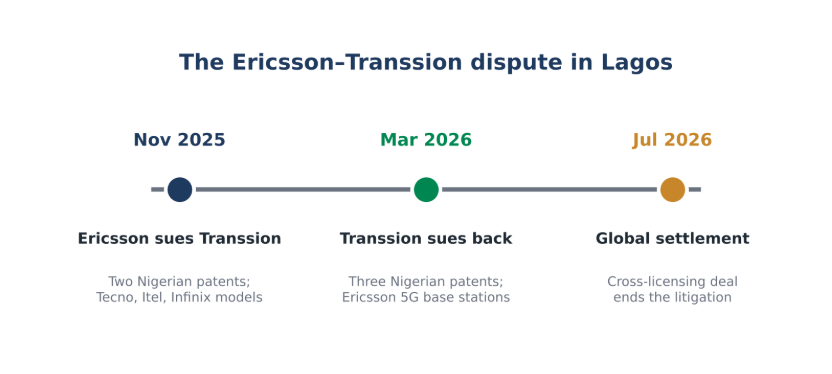
In November 2025, something unusual happened at the Federal High Court in Lagos. Swedish telecommunications giant Ericsson brought a patent infringement lawsuit against Transsion, the Chinese company behind Tecno, Infinix and Itel. Ericsson sought court orders that could have restricted the sale and distribution of certain smartphones in Nigeria, alongside other remedies relating to allegedly infringing products.
Imagine walking into Computer Village in Lagos to buy a Tecno or Infinix phone, only to discover that certain models were unavailable because of a patent dispute between companies headquartered thousands of kilometres away. That did not happen. The parties eventually settled their dispute in July 2026. But the case raises a bigger question: why has Lagos become a battleground for global patent wars, and is its legal system prepared for the consequences?

How Did a Global Patent Dispute Reach Lagos?
Ericsson’s lawsuit was part of a wider international patent dispute involving proceedings in Brazil, India, Europe and several other jurisdictions.
At the centre of the disagreement were patents covering technologies used in mobile telecommunications.
Modern smartphones rely on numerous patented inventions to connect to networks, transmit data and communicate with other devices. Some are protected by standard essential patents (SEPs), which cover technologies necessary to implement recognised industry standards. Because manufacturers may have no practical alternative to using these technologies, SEP owners are generally expected to offer licences on fair, reasonable and non-discriminatory terms, commonly called FRAND.
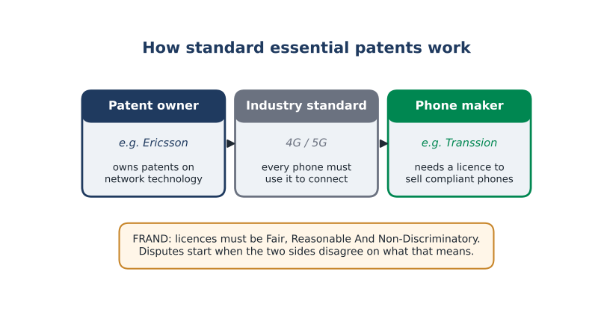
Disputes arise when companies disagree over infringement, licensing fees or what constitutes a reasonable licensing arrangement. Importantly, Ericsson was not simply attempting to enforce Swedish patents in Nigeria. Patent rights are territorial: protection in one country does not automatically extend to another. Ericsson’s Nigerian proceedings were based on patents protected under Nigerian law.
The court documents identified devices including the Tecno Spark 40 Pro+, Itel P55+ and Infinix Hot 60 Pro+. Ericsson alleged infringement of two Nigerian patents and sought injunctive and other remedies. These were allegations and requests, not judicial findings.
The proceedings were particularly significant because they represented the first publicly reported standard essential patent dispute in Nigeria.
The Unexpected Twist: Transsion Fought Back
The story became more interesting in March 2026 when Transsion commenced separate proceedings against Ericsson and its Nigerian subsidiary.
Transsion alleged that certain Ericsson 5G base station equipment infringed three Nigerian patents relating to telecommunications technologies. Its filings identified Ericsson equipment and sought injunctive and financial remedies.
In other words, both companies were asserting locally protected patent rights against each other before Nigerian courts. Both are multinational corporations with significant commercial interests. Both sought to use Nigeria’s patent system to protect those interests. Lagos had become a venue for determining rights over commercially valuable technologies in a global telecommunications dispute.
Why Should Smartphone Users Care?
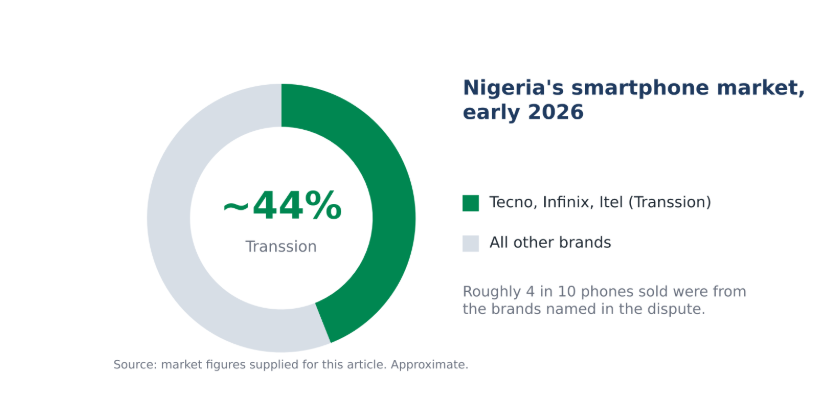
Transsion occupies a substantial position in Nigeria’s smartphone market. Its Tecno, Infinix and Itel brands collectively accounted for approximately 44% of the market in early 2026, according to the market figures supplied for this article.
For many households, these devices are more than communication tools. They provide access to banking, education, business opportunities and essential digital services. Where manufacturers face additional licensing costs, some expenses may eventually influence consumer prices. Where injunctions are granted, the availability of affected products may be disrupted. Neither consequence is automatic, and neither was an established outcome of this litigation.
Nevertheless, the case demonstrates how disputes over technologies largely invisible to consumers can potentially affect products on which millions depend.
A Bigger Question: Who Owns the Technology?
Nigeria is a major market for smartphones and telecommunications services. Yet much of the underlying technology is developed, patented and commercially controlled outside the country.
Ericsson owns Nigerian patents relating to telecommunications technologies. Transsion also asserted Nigerian patent rights in its separate litigation. Both companies were therefore relying on intellectual property protection granted within Nigeria. But the existence of locally registered patents does not necessarily mean that the underlying inventions originated locally. A foreign company can protect its inventions in Nigeria, enforce those rights before Nigerian courts and earn commercial returns from the Nigerian market.
There is nothing inherently wrong with this. Territorial patent protection is fundamental to international intellectual property law. The concern is that Nigeria remains a substantial consumer market without a comparable presence in the ownership and development of the technologies powering that market.
Are we building economies that merely consume sophisticated technologies, or institutions and businesses capable of creating, protecting and commercialising them?
Is a Patent Law Dating from 1971 Ready for Today’s Technology?
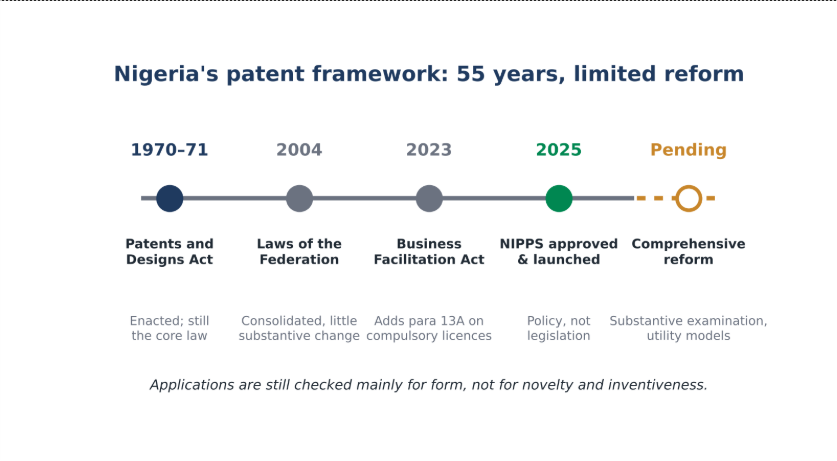
Nigeria’s Patents and Designs Act originated in 1970 and commenced in 1971. Although subsequently amended and consolidated in the Laws of the Federation of Nigeria 2004, its underlying framework has seen relatively limited substantive modernisation.
The Business Facilitation (Miscellaneous Provisions) Act 2023 introduced paragraph 13A into the First Schedule of the Patents and Designs Act, empowering the Minister to prescribe regulations governing the application, grant, use and withdrawal of compulsory licences under the relevant provisions. Compulsory licensing allows patented inventions to be used without the patent owner’s consent in legally prescribed circumstances. The amendment is relevant, but it does not comprehensively address the demands of modern patent litigation, particularly disputes involving telecommunications standards and complex licensing arrangements.
Broader repeal-and-re-enactment proposals have sought to modernise patent protection and administration. Proposed reforms have included utility models and substantive patent examination, but comprehensive reform remains unfinished. Nigeria still operates a largely formal patent examination system, meaning applications are not subjected to comprehensive technical examination of novelty and inventiveness before registration.
How should a court determine whether a patent is genuinely essential to a technical standard? How should it evaluate competing licensing offers? What technical expertise is available to assist judges? These questions concern whether legal infrastructure has kept pace with technological and commercial realities.
A New Intellectual Property Policy Without Legal Teeth?
Nigeria’s National Intellectual Property Policy and Strategy (NIPPS), approved in November 2025 and formally launched in December, represents an encouraging development. The framework recognises intellectual property as important to innovation, investment, technology transfer and economic development. But what can a national intellectual property strategy achieve if the legislation and institutions needed to implement it remain inadequate?
NIPPS is a policy framework, not a substitute for legislation. It cannot independently establish a substantive patent examination system, create new enforceable patent rights or resolve the complex legal questions surrounding standard essential patent licensing. Implementation committees are a welcome administrative step. But committees and policy commitments must translate into legislative reform, institutional capacity and measurable results. Without that transition, NIPPS risks becoming another ambitious policy document with limited practical effect.
The objective should not merely be stronger enforcement of foreign-owned patents. It should be a balanced system that encourages innovation while protecting competition and access to affordable technologies.
The Litigation Ended. The Bigger Questions Remain.
In July 2026, Ericsson and Transsion announced a global settlement and cross-licensing agreement, bringing their litigation to an end.
As Africa’s digital markets expand, international technology companies will increasingly view them not only as destinations for products but also as important jurisdictions for enforcing intellectual property rights. The Ericsson–Transsion dispute is a reminder that technological influence is not measured simply by how many smartphones a country consumes, but also by its ability to develop, own and govern the technologies on which its economy depends.
The next global patent battle may already be taking shape. The question is whether Lagos will merely host it or help shape the legal and technological future it represents.
About the Author
Dr Tolulope Adekola is a dual-qualified attorney admitted in Australia and Nigeria, a researcher, and a Lecturer at the Thomas More Law School, Australian Catholic University. His research spans intellectual property and innovation policy, public health law, law and technology, and African history in the context of innovation.